

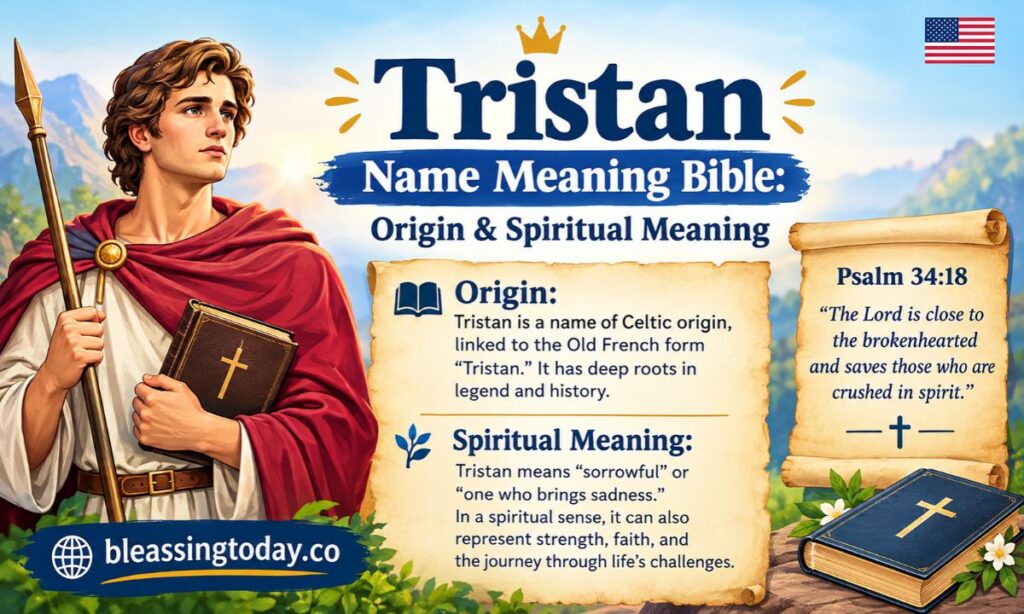
Tristan name meaning Bible is one of the most searched questions among parents who love this name. The short answer is that Tristan does not appear anywhere in Scripture. It comes from Celtic and Latin roots instead.
Even so, the name often means “sorrowful,” and that idea fits well with Bible stories of pain turning into hope. This guide covers its origin, its spiritual side, and how it looks in Hebrew and Greek.
What Does the Name Tristan Mean?

- Tristan most often means “sad” or “sorrowful.”
- That meaning comes from the Latin word tristis.
- Old French later shaped it into the name Tristan.
- A Celtic root, Drust, is often linked to “tumult” or “outcry.”
- Scholars still disagree about which root came first.
- People looking up the Tristan name meaning Bible usually land on the “sorrowful” meaning first.
- Common spellings include Tristen, Triston, Tristin, and Tristram.
- Today, Tristan is mostly given to boys.
- The Tristan Stone in Cornwall carries an early form, Drustanus.
- That stone is dated to around the 6th century.
- Some sites say Tristan means “triumphant,” but trusted name sources do not back this up.
- A name’s meaning does not decide a person’s future.
- Always check any Tristan name meaning Bible claim against at least two sources.
- Good sources name the language the meaning comes from.
- Be careful with sites that list meanings without any origin.
Is Tristan Mentioned in the Bible?
- No, the name Tristan is not in the Bible.
- It does not appear in the Hebrew Old Testament.
- It is missing from the Greek New Testament too.
- The Septuagint, the old Greek Old Testament, does not have it either.
- Bible names come from Hebrew, Aramaic, and Greek.
- Tristan comes from Celtic and Latin roots instead.
- So the first answer to the Tristan name meaning Bible question is a clear no.
- The name became popular through medieval stories, not Scripture.
- Abraham, Mary, and David are Bible names. Tristan is not one of them.
- A name missing from the Bible is not a wrong name.
- Many Christian families use names that are not in Scripture.
- Tristan has a long history and a strong sound, which many parents like.
- Some parents still prefer a name with a Bible verse behind it.
- If that matters to you, pick a name that appears in Scripture.
- Otherwise, Tristan can still carry a faith based meaning for your family.
Spiritual Significance of the Name Tristan

- The Bible gives Tristan no official spiritual meaning.
- But the “sorrowful” meaning links to a big biblical theme.
- The Bible talks often about sorrow and comfort.
- Psalm 30:5 says weeping may last a night, but joy comes in the morning.
- John 16:20 promises that sorrow will turn into joy.
- Matthew 5:4 says those who mourn will be comforted.
- Isaiah 53:3 calls Jesus a “man of sorrows.”
- The spiritual side of the Tristan name meaning Bible readers look for is hope after pain.
- Job’s story shows deep sorrow and lasting faith.
- Many Christians see Tristan as a name of endurance.
- The Bible teaches that sorrow is never the final chapter.
- This is a Christian reading, not official church teaching.
- The name can inspire a story of resilience.
- Some parents may still dislike a name that means “sad.”
- A hopeful middle name, like Gabriel or Elijah, can balance it.
Tristan in Biblical History and Tradition
- Tristan was not a person in biblical history.
- The Bible was complete long before this name appeared.
- The Tristan legend grew during the Middle Ages.
- Early forms of the name show up in 6th century Britain.
- The Tristan Stone in Cornwall shows the form Drustanus.
- A Pictish saint named Drostan used a related form of the name.
- Drostan is a Christian saint, but he is not in the Bible.
- Medieval Christian Europe kept the Tristan story alive in books and songs.
- So the Tristan name meaning Bible link is cultural, not scriptural.
- Tristan is not commonly listed among the major saints’ names.
- Some writers compare Tristan’s story to biblical tales of suffering.
- Those comparisons are symbolic, not historical.
- Most of this topic is about symbolism, not history.
- If a blog claims Tristan is in Scripture, ask for the verse.
- If there is no verse, the claim is not true.
The Origin of Tristan in Celtic and Christian Culture

- Tristan’s roots are Celtic, from Cornish and Breton lands.
- Cornish and Breton are PCeltic languages, like Welsh.
- The oldest forms are usually given as Drustan or Drust.
- Some scholars link the name to a Pictish king named Drust.
- The Old French form Tristan then spread across Europe.
- Medieval poets retold the love story of Tristan and Isolde.
- Gottfried von Strassburg wrote a famous version in the early 1200s.
- Composer Richard Wagner later turned the story into an opera.
- The Latin word tristis shaped how people understood the name: “sad.”
- So the name mixes a Celtic origin with a Latinstyle meaning.
- Christian Europe adopted the name widely, even without a Bible link.
- Today it is used in the USA, the UK, and France.
- When you look at the Tristan name meaning Bible question, origin is the strongest fact.
- Cornwall and Brittany are the key places in its history.
- Those two regions explain why the name sounds so Celtic.
Biblical Names Similar to Tristan
- No biblical name is the same as Tristan.
- But a few Bible names share its “sorrow” meaning.
- Benoni means “son of my sorrow” (Genesis 35:18).
- Jacob renamed him Benjamin, “son of the right hand.”
- Jabez sounds like the Hebrew word for pain (1 Chronicles 4:9).
- Jabez prayed to God and was blessed (1 Chronicles 4:10).
- Mara means “bitter,” and Naomi chose it for herself (Ruth 1:20).
- Ichabod means “no glory” (1 Samuel 4:21).
- Some Bible names only sound close, like Trophimus (Acts 20:4).
- Tryphena and Tryphosa are two women named in Romans 16:12.
- Trophimus is linked to a Greek word for nourishment.
- These names match Tristan’s sound, not its meaning.
- For sorrow tojoy stories, Benoni and Jabez fit best.
- Jabez is the closest story to the Tristan name meaning Bible readers want.
- Biblical alternatives give you verses, but they are less common names in the USA.
Why Parents Choose Tristan: A Biblical Perspective

- Many parents love the strong, romantic sound of Tristan.
- It feels both classic and modern.
- Tristan ranked #267 among US boys’ names in 2024, per SSA data.
- About 123,000 US babies have been named Tristan since 1946, per SSA data.
- The peak year was 2008, with about 5,659 births.
- Use has since fallen to about 1,296 births in 2024.
- Some parents like the legend’s themes of courage and loyalty.
- Christian parents often focus on hope after sorrow.
- Others choose it for a child born after a hard season.
- It is distinctive without being too rare.
- Easy nicknames like Tris are available.
- The “sad” meaning may bother some families.
- There is no Scripture namesake to point to.
- For many families, the Tristan name meaning Bible angle is about symbolism, not a verse.
- Telling your child the meaning in a hopeful way makes a big difference.
Tristan Name Meaning in Hebrew and Greek
- Tristan has no original Hebrew meaning.
- It has no original Greek meaning either.
- Some sites list Hebrew meanings like “tumult” or “of the sea.”
- Those claims lack solid language support.
- “Tumult” actually matches the Celtic root Drust, not Hebrew.
- Hebrew has its own word for sorrow, yagon (Psalm 31:10).
- The Hebrew root behind Jabez relates to pain.
- Greek uses lypē for sorrow, as in John 16:20.
- These words explain the idea of Tristan’s meaning, not its origin.
- Tristan itself is Celtic and Latinbased.
- In Hebrew letters it is written טריסטן.
- In Greek letters it is written Τριστάν.
- Writing a name in another alphabet does not change its origin.
- For Tristan name meaning Bible in Hebrew and Greek, think related words, not roots.
- Blue Letter Bible and Strong’s Concordance help you check real Hebrew and Greek words.
The Cultural and Religious Impact of the Name Tristan

- Tristan and Isolde is one of Europe’s best known love stories.
- The tale shaped Arthurian legend in medieval times.
- Wagner’s opera Tristan und Isolde premiered in 1865.
- Portuguese explorer Tristão da Cunha sighted the Tristan da Cunha islands in 1506.
- Those islands lie in the South Atlantic Ocean.
- The name is common in Britain, France, and the USA.
- Medieval courts loved the story.
- Some Christian readers see it as a lesson on loyalty and temptation.
- Tristan appears often in modern books, films, and TV.
- About 43,299 US babies were named Tristan in the 2000s, per SSA data.
- About 38,678 were named Tristan in the 2010s, per SSA data.
- This shows a name can be loved for culture, not Scripture.
- Its religious impact is mostly symbolic.
- The Tristan name meaning Bible trend shows how people link culture to faith.
- Sharing both the legend and the Christian symbolism gives your child the full story.
What the Bible Teaches About Names and Identity
- In the Bible, names often show character or purpose.
- God changed Abram to Abraham in Genesis 17:5.
- Jacob became Israel in Genesis 32:28.
- Jesus renamed Simon as Peter in Matthew 16:18.
- Saul is also called Paul in Acts 13:9.
- Isaiah 43:1 says God calls His people by name.
- Proverbs 22:1 says a good name is worth more than great riches.
- Revelation 2:17 promises a new name to the one who overcomes.
- Bible names carry meaning, but meaning does not fix fate.
- Jabez shows that a painful name can lead to blessing.
- This idea helps readers apply the Tristan name meaning Bible lesson.
- Character matters more than the label of a name.
- In Scripture, identity comes from God, not from a dictionary meaning.
- This view frees “sad” names from stigma.
- Still, a name is not a prophecy, so avoid overspiritualizing it.
Tristan Name Meaning Bible Pronunciation
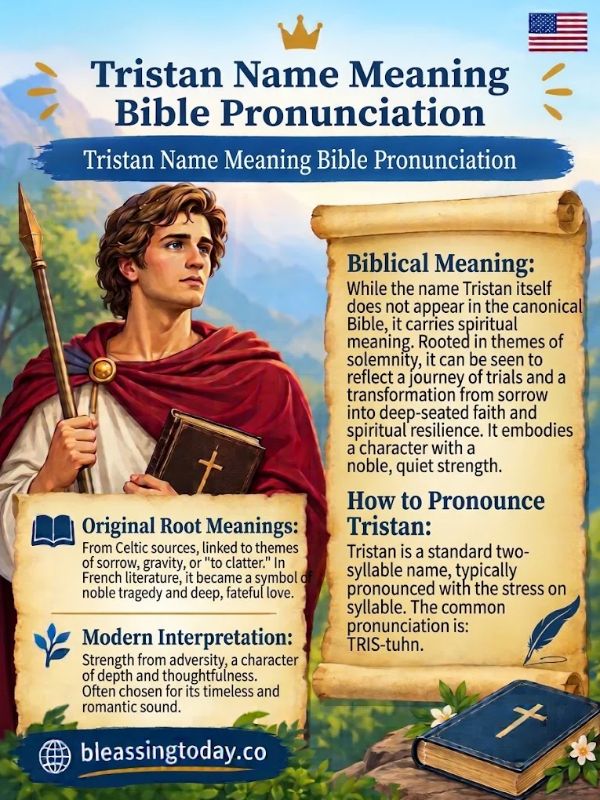
- Tristan is pronounced TRIStuhn.
- The IPA spelling is /ˈtrɪstən/.
- The stress falls on the first syllable.
- Some people say TRIStin in casual speech.
- The final “a” is a soft, short sound.
- French speakers say trisTAHN, with stress at the end.
- Tristan has two syllables.
- Tristen, Triston, and Tristin sound almost the same.
- Tristram is a longer, older form.
- The Tristan name meaning Bible pronunciation is easy for most US speakers.
- There is no Bible pronunciation, since the name is not in the Bible.
- The nickname Tris sounds like “triss.”
- It is easy to say and spell.
- Many spelling choices can cause mixups on forms.
- Say the full name aloud before you decide.
What Is the Biblical Meaning of My Name?
- Start by finding your name’s origin.
- Check if it is Hebrew, Greek, Aramaic, or Latin.
- Search whether it appears in a Bible verse.
- Use a trusted tool like Blue Letter Bible or Strong’s Concordance.
- Samuel means “God has heard.”
- David is often given as “beloved.”
- Daniel means “God is my judge.”
- If your name is not in the Bible, study its meaning.
- Match that meaning to a Bible theme.
- For Tristan, the theme is sorrow turning to joy.
- Find a verse that fits, like Psalm 30:5.
- Read the story around the verse.
- Do not force a meaning. Be honest about the gap.
- A biblical meaning is either found in Scripture or drawn from a theme.
- For Tristan name meaning Bible seekers, this simple method works well.
Tristan Meaning Bible in Greek

- The New Testament was written in Greek.
- Tristan does not appear in the Greek New Testament.
- The Latin tristis is close in idea to Greek words for sadness.
- The Greek word lypē means grief or sorrow.
- John 16:20 uses lypē when it says sorrow will become joy.
- 2 Corinthians 7:10 speaks of godly sorrow, also using lypē.
- The Greek verb penthéō means to mourn, as in Matthew 5:4.
- These words link Tristan to the Greek Bible in idea only.
- The Septuagint uses Greek words for Hebrew sorrow terms.
- The Greek spelling of Tristan is Τριστάν.
- Spelling a name in Greek does not make it a Greek name.
- A related sounding Greek Bible name is Trophimus.
- Tryphena also starts with a similar sound.
- A true Tristan meaning Bible in Greek answer is “no direct match, but a related idea.”
- A Greek interlinear tool helps you check any claim.
Tristan Meaning Bible in English
- In English, Tristan means “sorrowful” or “sad.”
- Some name books give “tumult” as the Celtic meaning.
- English Bibles do not contain the name Tristan.
- This is true of the KJV, NIV, and ESV.
- English Bibles do have many verses about sorrow and hope.
- Psalm 34:18 says the Lord is near to the brokenhearted.
- Psalm 126:5 says those who sow in tears will reap with joy.
- These verses match the Tristan name meaning Bible idea in English.
- In plain words, it is not in the Bible, but it is hopeful in spirit.
- Tristan may mean sorrowful, yet Scripture promises joy after tears.
- The meaning gives parents a deep story to share.
- The plain English meaning can sound negative.
- Use “sorrowful,” not “triumphant,” when you write about it.
- Always say it is “not directly in the Bible.”
- Keep the tone hopeful and honest.
Frequently Asked Questions
Is Tristan a biblical name?
No. Tristan is not in the Bible. It has Celtic and Latin roots.
What does Tristan mean in the Bible?
It has no meaning in Scripture. Its “sorrowful” meaning fits Bible themes like Job’s endurance and sorrow turning into joy.
What does Tristan mean in Hebrew?
Tristan has no Hebrew origin. The Hebrew word for sorrow is yagon, but it is not the root of Tristan.
Is Tristan a good Christian name?
Yes, many Christians use it. It is not in Scripture, but its meaning fits themes of hope after pain.
How do you pronounce Tristan?
Say TRIS tuhn, with the stress on the first syllable.
Which Bible name is closest to Tristan?
Benoni and Jabez are closest in meaning. Trophimus is closest in sound.
How popular is Tristan in the USA?
It ranked #267 for boys in 2024, per SSA data. It peaked in 2008 with about 5,659 births.
Conclusion
Tristan name meaning Bible comes down to one clear fact: the name is not in Scripture. Its roots are Celtic and Latin, and it means “sorrowful.” Still, it connects well with Jabez, Job, and the Bible promise of sorrow turning into joy.
If you are thinking of Tristan for your baby, read Psalm 30:5 and John 16:20 together. See if that message fits your family’s faith. Share this guide with someone exploring Bible names, and check the related guides below.
